GUIDES · DOTS AND BOXES
How to win at Dots and Boxes: chains, sacrifices and timing
Dots and Boxes looks like a game of grabbing boxes. Good players know it is really a game about who is forced to open the board first.
The basic rules, briefly
Two players take turns drawing a line between two neighbouring dots. Whoever draws the fourth side of a square claims it and scores a point. In the classic pencil-and-paper game, completing a box also earns another move, so one turn can sweep a whole row of boxes. When every line is drawn, the player with more boxes wins.
That extra-move rule is what makes the classic game deep. It turns the second half of a game into a sequence of long captures, and the player who controls who captures what usually wins, even if they are behind on boxes for a while.
Phase one: safe lines
At the start almost every line is safe. A line is unsafe if it becomes the third side of a box, because your opponent can then draw the fourth side and take it. In the opening, simply avoid drawing the third side of any box. Spread your lines across the board instead of building in one corner: you want to keep your options open for as long as possible.
Count while you play. Eventually the safe lines run out, and someone has to draw a third side. Ideally that is your opponent, and the box they give away is a small one.
Phase two: chains and loops
Once the safe lines are gone, the board breaks into chains (rows of boxes where taking one lets you take the next) and loops (chains that close back on themselves). A chain of one or two boxes is a short chain; three or more is a long chain.
When you are forced to give something away, give the smallest thing available. Hand over a one-box or two-box chain before you open a long one. Every box you give away is a box your opponent scores, so you want the gifts to be cheap.
The double-cross: giving two boxes to keep control
Here is the move that separates beginners from strong players. When your opponent opens a long chain for you, you do not have to take every box. Take all of them except the last two, then draw the line at the far end so that those two boxes form a pair your opponent must take. This is often called a double-cross or the "all but two" trick.
Why give two boxes away? Because after your opponent takes them, they have to move again, and the next thing they draw opens the next chain for you. You sacrifice two boxes to keep control of every chain that follows. On a board with several long chains, that trade wins comfortably.
The same idea works with loops, but a loop costs four boxes to decline rather than two, so it is only worth doing when plenty of boxes are still to come.
The long-chain rule
Mathematician Elwyn Berlekamp, who wrote the best-known book on the game, summed up the fight for control with a counting rule. On a rectangular board, the first player wants the number of dots plus the number of long chains to be even; the second player wants it to be odd. You do not need to memorise it to enjoy the game, but it explains why strong players spend the middle of a game quietly shaping how many long chains there will be, merging two short chains into one long one or cutting a long chain in half.
A simple plan for your next game
- Draw safe lines and avoid making the third side of any box.
- As the safe lines run out, count the chains that are forming.
- When you have to give something away, give the smallest chain on the board.
- When you are handed a long chain near the end, think about taking all but two.
- Keep the last word: the player who takes the final long chain usually wins.
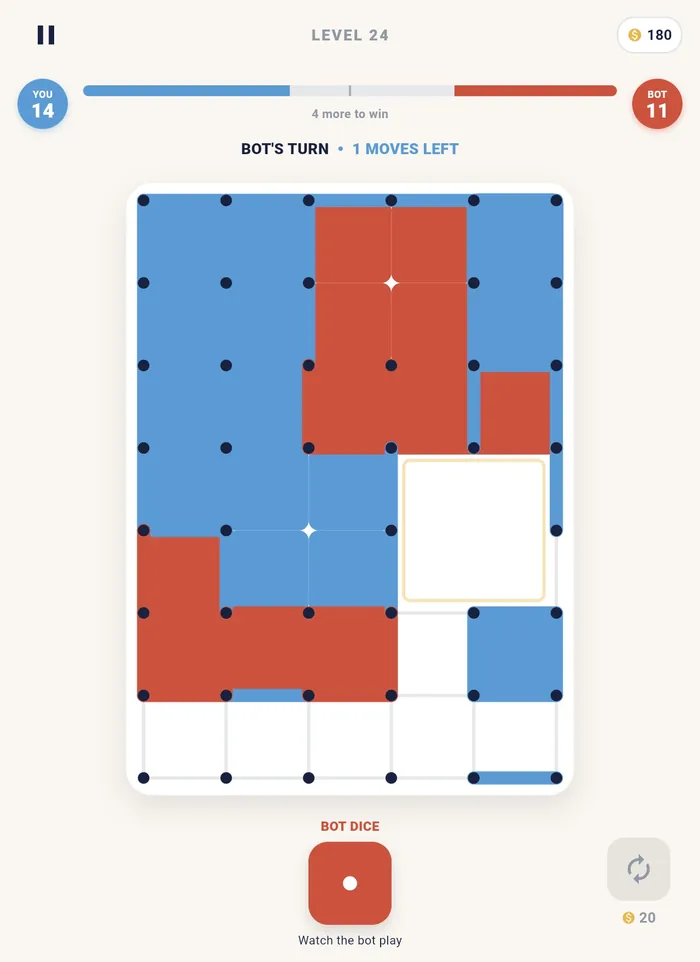
How this applies in our dice version
Our Dots and Boxes adds dice. You roll, then draw exactly as many lines as the dice shows, and closing a box does not give you an extra line. That changes the maths: a long chain is no longer something one player sweeps in a single turn, because your roll decides how far you get. The core habits still pay off, though. Avoid drawing third sides when you can, notice which boxes are one line from completion, and use the last moves of a roll on lines that do not hand the bot an easy box. Our guide to the dice version covers rerolls, power dice and mega boxes.
Questions players ask
Is it better to go first or second in Dots and Boxes?
Neither is automatically better on a typical board. What matters is which player ends up forced to open the long chains, which is why the long-chain rule talks about the number of dots plus long chains rather than about who started.
Should I ever refuse free boxes?
Yes, but only near the end. Declining the last two boxes of a long chain keeps control of the chains that follow. Early in a game, or when only one chain is left, take everything you are offered.
What counts as a long chain?
A chain of three or more boxes. One-box and two-box chains are short chains, and they are the ones you want to hand over when you are forced to give something away.
Does this work against the bot in My Game Basket?
Partly. In our dice version you draw as many lines as you roll and closing a box does not earn an extra line, so the chain-control tricks matter less. Avoiding third sides and counting what each move gives away still help on every level.
Ready to put this into practice?
Play Dots and Boxes free