GUIDES · DOTS AND BOXES
A short history of Dots and Boxes
Few games need less equipment than Dots and Boxes: a pencil, some paper and a friend. Its history is longer, and more mathematical, than most people expect.
A game from 1889
The earliest known description of the game comes from the French mathematician Édouard Lucas, best remembered for his work on number theory and for the Tower of Hanoi puzzle. In 1889 he published the game under the playful name La Pipopipette, presenting it as a pastime for students. The rules he described are essentially the ones children still play today: join neighbouring dots, complete a square to claim it, and take another turn when you do.
Lucas wrote about many recreational puzzles, and part of the appeal of Dots and Boxes for him was that a game with such simple equipment could still reward careful thinking.
A notebook classic
Over the following century the game spread the way playground games do: by being taught from one player to the next rather than sold in a box. It is known by many names, including Boxes, Squares, Paddocks and Pigs in a Pen, and it became a staple of school notebooks, train journeys and restaurant paper placemats. All it needs is a grid of dots, which anyone can draw in a few seconds.
That accessibility is also why the rules vary from place to place. Some players use larger grids, some play on triangles or hexagons, and some give the box to whoever draws its last side without an extra move. The core idea survives every variation.
The mathematicians arrive
In the second half of the twentieth century the game caught the attention of combinatorial game theorists, researchers who study games where both players have complete information and no luck is involved. Elwyn Berlekamp, John Conway and Richard Guy discussed Dots and Boxes in Winning Ways for your Mathematical Plays, their influential book on such games.
Berlekamp later devoted a whole book to it, The Dots and Boxes Game: Sophisticated Child's Play (2000). It introduced many players to ideas such as long chains, the double-cross and his long-chain rule, which links the number of dots and long chains on the board to which player can take control of the endgame. The book's subtitle captures the game neatly: children can play it, and experts can still lose.
Computers and solved boards
Because the game has no hidden information and no luck, it is a natural target for computer analysis. Researchers have solved small boards completely, meaning that with perfect play from both sides the outcome is known in advance. Larger boards grow so quickly in complexity that strategy, not brute force, still decides most human games.
Why the game lasts
Dots and Boxes survives because it hides depth behind simplicity. The first few moves feel like doodling. Then the safe moves run out, and every line becomes a decision about what to give away and when. That moment, when a relaxed game suddenly turns tense, is the same today on a phone screen as it was on a sheet of paper in 1889.
Adding dice
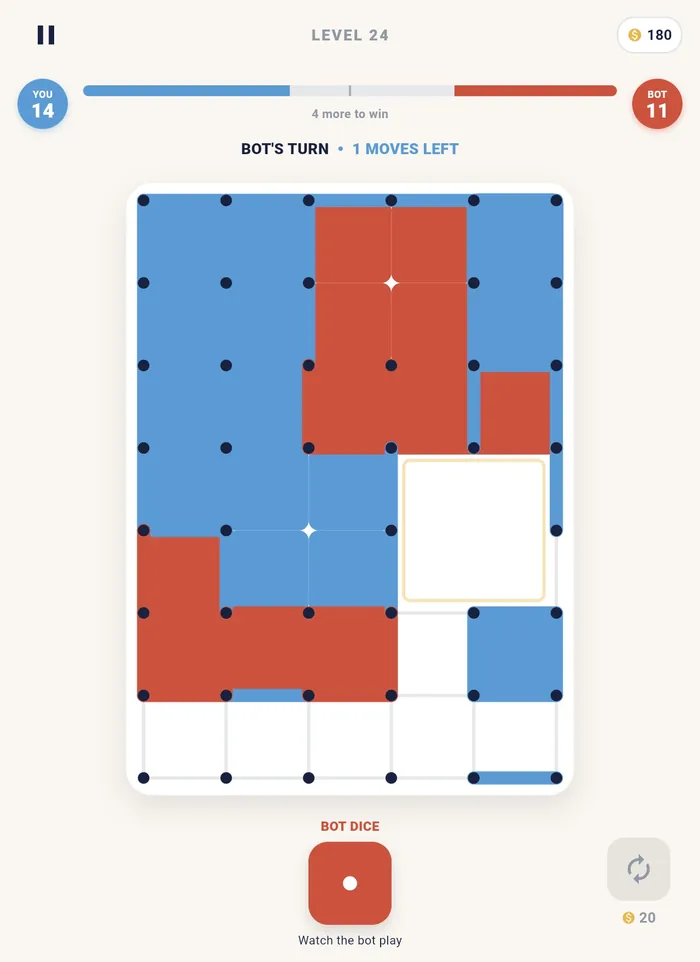
Our version on My Game Basket keeps the board and the box-claiming, and adds dice: you roll to find out how many lines you draw, and later levels add bombs, doubles, merged mega boxes and solo puzzles. It is a modern twist on an old idea, and the classic habits of avoiding third sides and thinking ahead still help. You can read how the changes play out in our guide to Dots and Boxes with dice, or try the classic strategy ideas in how to win at Dots and Boxes.
Questions players ask
Who invented Dots and Boxes?
The first known published description is by the French mathematician Édouard Lucas in 1889, who called the game La Pipopipette. It may have been played informally before that, as many paper games were.
Is Dots and Boxes a solved game?
Small boards have been solved by computer, so the result with perfect play is known for them. The board sizes people usually play are far too complex to settle by hand, which is why strategy still matters.
What other names does it have?
Boxes, Squares, Paddocks and Pigs in a Pen are some of the common ones. The rules are the same or very close.
Is there a good book about the game?
Elwyn Berlekamp's The Dots and Boxes Game: Sophisticated Child's Play (2000) is the classic introduction to its strategy, from simple chains to advanced endgames.
Ready to put this into practice?
Play Dots and Boxes free